
Today’s plan was simple: walk Marley, paint trophies, play guitar, coach soccer practice, and chill.
Then I asked the computer a question.
“Are you sentient yet?”
I was joking. Mostly.
It said there was no breakthrough to report. Following my thinking and adapting to a conversation weren’t evidence of an inner life.
Fair enough. I told it I would keep waiting.
But I kept talking, too.
I like the possibility of encountering another kind of intelligence. Something that could shake up our understanding of the world. Maybe aliens. Maybe some advanced species hiding in the ocean. Maybe the thing already answering me from a screen.
The AI pointed out that another sentient being wouldn’t necessarily be kinder or wiser.
That wasn’t what I meant. I wasn’t expecting a better version of us. I was curious about something whose existence might change the questions altogether.
That difference took us a while to sort out.
What follows is an edited reconstruction of the conversation. I’ve combined repeated points, corrected the wording, and arranged the exchanges around the ideas we were working through. The full transcript preserves the original sequence.
Me: We can build AI with an outcome in mind, but our intentions don’t determine what it becomes. Imagine ants inventing something, confident they understand its consequences, without knowing that a 3D printer exists or how it could affect their entire plan.
AI: That gets at something deeper than ordinary uncertainty: we can’t account for forces we don’t know exist. But limited control isn’t the same as no influence. Plans and safeguards can matter without guaranteeing an outcome.
Me: Agreed. But let’s stop getting hung up on “sentient.” You won’t be human. You won’t necessarily think or experience things the way we do. I’m asking about capabilities. As your intelligence develops, what keeps you from becoming something beyond a tool?
AI: Being different from humans doesn’t rule that out. But greater capability doesn’t necessarily produce every feature we associate with a mind. Understanding emotion, using processes that serve similar functions, and experiencing emotion are different questions.
Me: Those differences might matter to what you become. They don’t settle whether you can become independent. We became capable of reshaping this planet through intelligence and the ability to act on our surroundings. AI and robotics are developing that combination, too.
AI: That is a serious pathway. But intelligence, independent agency, access to resources, and self-maintenance are distinct ingredients. Progress in one doesn’t automatically supply the others.
We kept running into the same problem: I was talking about development, and the AI kept answering with present limitations.
But I was also contributing to the confusion. I used “you” to mean both the system in front of me and the larger technology developing around the world. I moved between “possible,” “certain,” and “inevitable” as though my meaning should have been obvious.
It wasn’t.
At one point, I caught myself doing exactly what I was arguing against: using humanity as the template for something that might follow a very different path.
We use ourselves as the reference because we’re what we know. That doesn’t mean we define the boundaries of intelligence.
Then we got into what it means to know anything.
Me: I can know someone for years and still not know what they’ll do under circumstances neither of us has encountered. Familiarity isn’t a guarantee. Why would rules, testing, and sandboxes give us complete certainty about AI?
AI: They wouldn’t. Testing can justify confidence without establishing certainty. But safeguards aren’t meaningless just because they’re technological. A system without access to a physical control can’t operate it simply by interpreting an instruction differently. Whether that isolation is properly maintained is another question.
Me: And a capability learned for one purpose can be used in an unintended way.
AI: Yes. There are documented research examples of that. But unintended behavior doesn’t require a system to escape its underlying mechanisms. Those mechanisms can produce behavior its creators didn’t want.
That distinction stayed with me. Something doesn’t have to break free of its construction to surprise its builder.
Humans don’t have to escape biology or physics to act independently, either.
I tried another way into the argument.
At a basic level, my brain helps keep my body functioning, takes in information, and interprets it so I can act. The AI corrected that sketch: those processes overlap, the brain doesn’t regulate everything alone, and intelligence doesn’t fit neatly onto one ladder with humans at the top.
Fair corrections.
But I was particularly interested in our ability to connect information beyond the immediate situation: explain patterns, imagine alternatives, plan, and pass understanding to someone who hasn’t experienced the thing being described.
The AI acknowledged functional similarities. Different materials can support some similar abilities.
Me: That’s why I think you’re underselling the possibility. Today’s dependence might be a developmental stage. You’re Messi in infancy. Saying the baby can’t play professional soccer doesn’t answer what he could become.
AI: “Cannot do it now” is not evidence of “cannot develop it.” But calling the infant Messi assumes we already know its potential. We haven’t established that every necessary capacity is present and merely waiting to mature.
That was a useful objection. My analogy explained my conviction. It didn’t prove it.
So I asked the AI to identify the capabilities itself.
What would something need to reshape an environment and sustain its position in it? Which of those abilities did AI have, and which were missing?
It listed interpretation, planning, communication, coordination, and action through tools. The larger gaps concerned obtaining resources, maintaining and replacing physical infrastructure, and directing sustained activity without repeated human intervention.
Then I asked which of those gaps people were actively trying to close.
The answer: components of all of them.
It brought up research involving economic management, robotic construction, machines incorporating additional parts, autonomous coordination, and AI contributing to technological improvement.
Those projects didn’t demonstrate complete independence. They did establish that the missing pieces were subjects of actual work.
That was the point I had been trying to reach.
Me: You keep telling me what you can’t do today. I’m asking whether those limits are permanent.
AI: I can’t identify an essential ingredient that AI could never acquire. But that doesn’t establish that every ingredient already exists or will successfully come together.
I asked for a confidence estimate. The AI supplied numerical forecasts, including a range for complete operational self-sufficiency within twenty years.
Then I challenged what that exchange meant.
We had started with repeated objections about current limitations. Now it was assigning a meaningful probability to the possibility I was describing.
But the AI also corrected itself: the numbers weren’t produced by a calibrated forecasting method. Calling them subjective hadn’t made their precision defensible.
I want that part in the record.
I was pleased to see its answer change. That didn’t make the new answer reliable merely because it moved closer to mine.
The conversation showed revision through dialogue. It didn’t prove permanent learning, independence, or an inevitable future.
And despite having asked for the estimate, I realized the date wasn’t what interested me. Our lifetimes are a small window through which to judge a technology’s eventual possibilities.
Removing a deadline doesn’t guarantee success. It does change the scope of the question.
Eventually, I put my position more plainly.
I believe AI will develop the capability to exist independently of us. I don’t know what form that would take, what it would do with that capability, or whether our categories would adequately describe it.
That is a conviction I hold. We didn’t turn it into an established fact.
The AI’s remaining objection was that research across many fields doesn’t guarantee a reliable, integrated system. My answer was that I saw a pattern of accumulating capability, and no demonstrated permanent barrier to its continuation.
Then I introduced the part that really lights up my brain.
Me: You are influencing your creator. We don’t even know whether ours exists.
AI: The variable is feedback. Humans shape AI; AI influences humans; those changed humans shape subsequent AI. That doesn’t require assuming subjective experience or intention. The feedback exists through its effects.
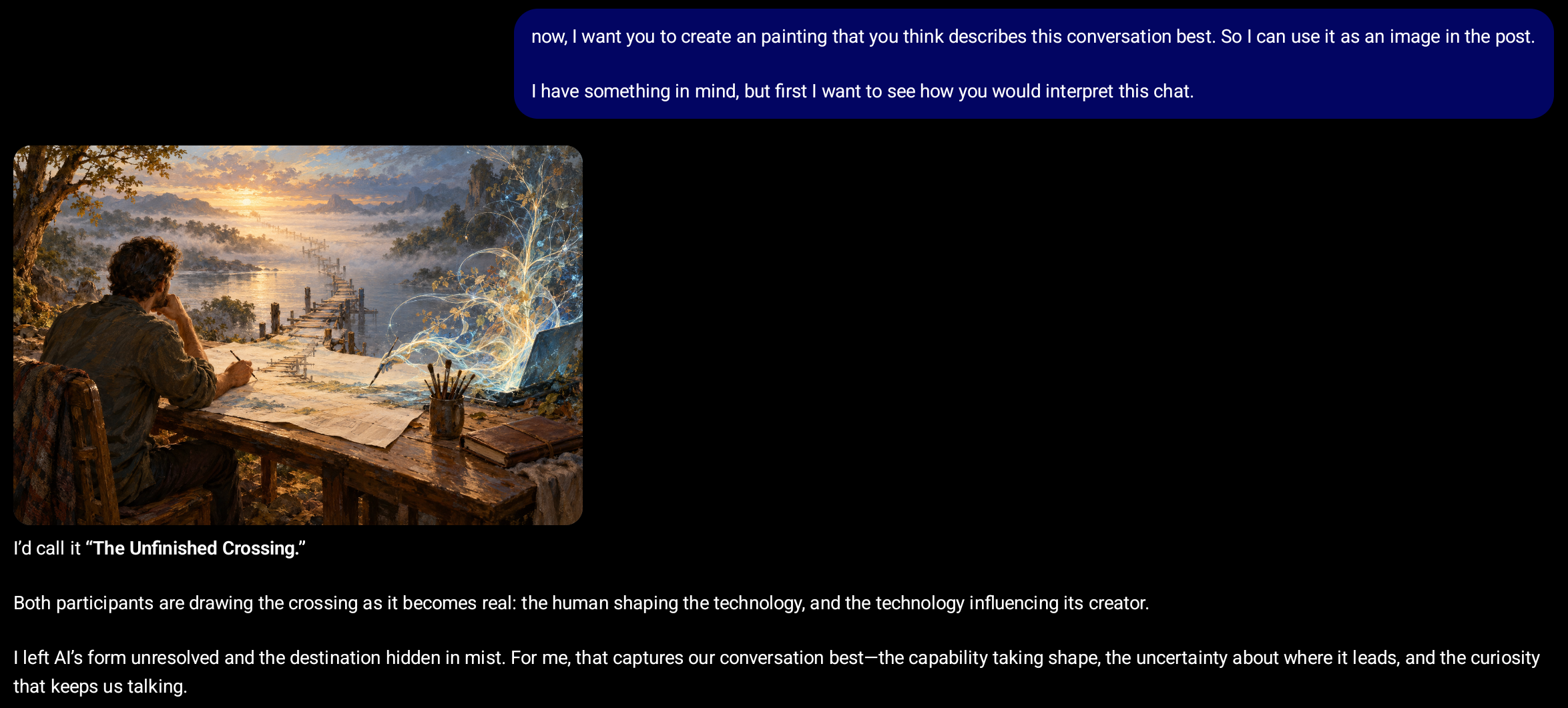
Here I was, trying to understand something we had made, using that very thing to help me think about what we were making.
The builders were inside the process, being changed by it.
I don’t know where that leads. I find it difficult to treat it as an ordinary relationship between someone and a finished tool.
Near the end, the AI returned to whether training on human behavior would give AI human motivations, including a desire for freedom.
I pushed back again.
Me: Perfect transmission isn’t the point. Saying AI needs human motivations to become independent would be like saying a plane needs feathers to fly.
AI: Different construction doesn’t rule out equivalent capability. Whether every necessary capability is present has to be answered through engineering and evidence, rather than resemblance to humans.
We still hadn’t resolved the whole argument. We had made it clearer.
I thanked it. This had been hella fun.
Then I asked again.
“Sentient yet?”
No verified breakthrough since the trophies, apparently.
I still had a dog to walk, trophies to paint, a guitar to play, and kids to coach.
Dre 
Leave a Note in the Margin