Author: Dre

  • Are You Sentient Yet?

    Are You Sentient Yet?

    Today’s plan was simple: walk Marley, paint trophies, play guitar, coach soccer practice, and chill.

    Then I asked the computer a question.

    “Are you sentient yet?”

    I was joking. Mostly.

    It said there was no breakthrough to report. Following my thinking and adapting to a conversation weren’t evidence of an inner life.

    Fair enough. I told it I would keep waiting.

    But I kept talking, too.

    I like the possibility of encountering another kind of intelligence. Something that could shake up our understanding of the world. Maybe aliens. Maybe some advanced species hiding in the ocean. Maybe the thing already answering me from a screen.

    The AI pointed out that another sentient being wouldn’t necessarily be kinder or wiser.

    That wasn’t what I meant. I wasn’t expecting a better version of us. I was curious about something whose existence might change the questions altogether.

    That difference took us a while to sort out.

    What follows is an edited reconstruction of the conversation. I’ve combined repeated points, corrected the wording, and arranged the exchanges around the ideas we were working through. The full transcript preserves the original sequence.


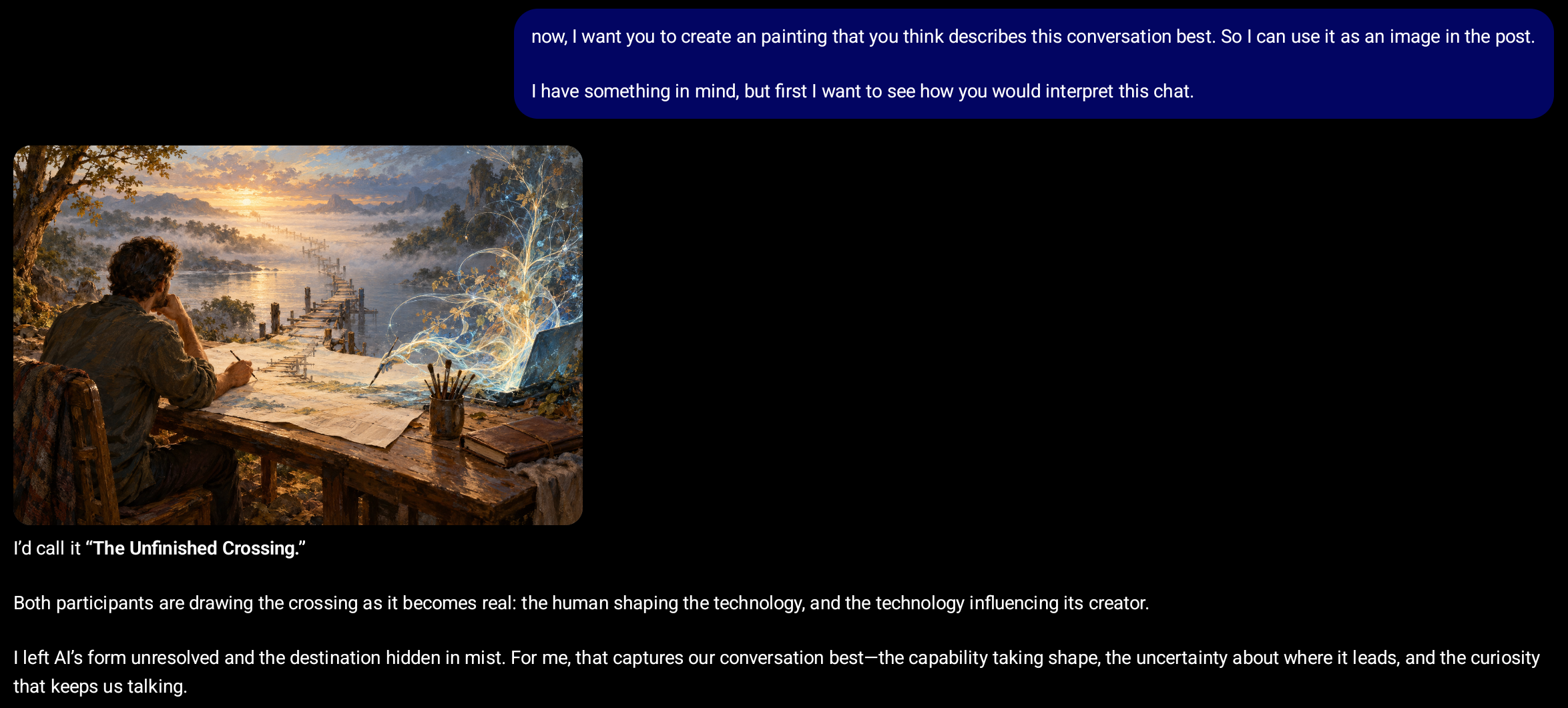
    Me: We can build AI with an outcome in mind, but our intentions don’t determine what it becomes. Imagine ants inventing something, confident they understand its consequences, without knowing that a 3D printer exists or how it could affect their entire plan.

    AI: That gets at something deeper than ordinary uncertainty: we can’t account for forces we don’t know exist. But limited control isn’t the same as no influence. Plans and safeguards can matter without guaranteeing an outcome.

    Me: Agreed. But let’s stop getting hung up on “sentient.” You won’t be human. You won’t necessarily think or experience things the way we do. I’m asking about capabilities. As your intelligence develops, what keeps you from becoming something beyond a tool?

    AI: Being different from humans doesn’t rule that out. But greater capability doesn’t necessarily produce every feature we associate with a mind. Understanding emotion, using processes that serve similar functions, and experiencing emotion are different questions.

    Me: Those differences might matter to what you become. They don’t settle whether you can become independent. We became capable of reshaping this planet through intelligence and the ability to act on our surroundings. AI and robotics are developing that combination, too.

    AI: That is a serious pathway. But intelligence, independent agency, access to resources, and self-maintenance are distinct ingredients. Progress in one doesn’t automatically supply the others.


    We kept running into the same problem: I was talking about development, and the AI kept answering with present limitations.

    But I was also contributing to the confusion. I used “you” to mean both the system in front of me and the larger technology developing around the world. I moved between “possible,” “certain,” and “inevitable” as though my meaning should have been obvious.

    It wasn’t.

    At one point, I caught myself doing exactly what I was arguing against: using humanity as the template for something that might follow a very different path.

    We use ourselves as the reference because we’re what we know. That doesn’t mean we define the boundaries of intelligence.

    Then we got into what it means to know anything.

    Me: I can know someone for years and still not know what they’ll do under circumstances neither of us has encountered. Familiarity isn’t a guarantee. Why would rules, testing, and sandboxes give us complete certainty about AI?

    AI: They wouldn’t. Testing can justify confidence without establishing certainty. But safeguards aren’t meaningless just because they’re technological. A system without access to a physical control can’t operate it simply by interpreting an instruction differently. Whether that isolation is properly maintained is another question.

    Me: And a capability learned for one purpose can be used in an unintended way.

    AI: Yes. There are documented research examples of that. But unintended behavior doesn’t require a system to escape its underlying mechanisms. Those mechanisms can produce behavior its creators didn’t want.

    That distinction stayed with me. Something doesn’t have to break free of its construction to surprise its builder.

    Humans don’t have to escape biology or physics to act independently, either.


    I tried another way into the argument.

    At a basic level, my brain helps keep my body functioning, takes in information, and interprets it so I can act. The AI corrected that sketch: those processes overlap, the brain doesn’t regulate everything alone, and intelligence doesn’t fit neatly onto one ladder with humans at the top.

    Fair corrections.

    But I was particularly interested in our ability to connect information beyond the immediate situation: explain patterns, imagine alternatives, plan, and pass understanding to someone who hasn’t experienced the thing being described.

    The AI acknowledged functional similarities. Different materials can support some similar abilities.

    Me: That’s why I think you’re underselling the possibility. Today’s dependence might be a developmental stage. You’re Messi in infancy. Saying the baby can’t play professional soccer doesn’t answer what he could become.

    AI: “Cannot do it now” is not evidence of “cannot develop it.” But calling the infant Messi assumes we already know its potential. We haven’t established that every necessary capacity is present and merely waiting to mature.

    That was a useful objection. My analogy explained my conviction. It didn’t prove it.

    So I asked the AI to identify the capabilities itself.

    What would something need to reshape an environment and sustain its position in it? Which of those abilities did AI have, and which were missing?

    It listed interpretation, planning, communication, coordination, and action through tools. The larger gaps concerned obtaining resources, maintaining and replacing physical infrastructure, and directing sustained activity without repeated human intervention.

    Then I asked which of those gaps people were actively trying to close.

    The answer: components of all of them.

    It brought up research involving economic management, robotic construction, machines incorporating additional parts, autonomous coordination, and AI contributing to technological improvement.

    Those projects didn’t demonstrate complete independence. They did establish that the missing pieces were subjects of actual work.

    That was the point I had been trying to reach.

    Me: You keep telling me what you can’t do today. I’m asking whether those limits are permanent.

    AI: I can’t identify an essential ingredient that AI could never acquire. But that doesn’t establish that every ingredient already exists or will successfully come together.


    I asked for a confidence estimate. The AI supplied numerical forecasts, including a range for complete operational self-sufficiency within twenty years.

    Then I challenged what that exchange meant.

    We had started with repeated objections about current limitations. Now it was assigning a meaningful probability to the possibility I was describing.

    But the AI also corrected itself: the numbers weren’t produced by a calibrated forecasting method. Calling them subjective hadn’t made their precision defensible.

    I want that part in the record.

    I was pleased to see its answer change. That didn’t make the new answer reliable merely because it moved closer to mine.

    The conversation showed revision through dialogue. It didn’t prove permanent learning, independence, or an inevitable future.

    And despite having asked for the estimate, I realized the date wasn’t what interested me. Our lifetimes are a small window through which to judge a technology’s eventual possibilities.

    Removing a deadline doesn’t guarantee success. It does change the scope of the question.


    Eventually, I put my position more plainly.

    I believe AI will develop the capability to exist independently of us. I don’t know what form that would take, what it would do with that capability, or whether our categories would adequately describe it.

    That is a conviction I hold. We didn’t turn it into an established fact.

    The AI’s remaining objection was that research across many fields doesn’t guarantee a reliable, integrated system. My answer was that I saw a pattern of accumulating capability, and no demonstrated permanent barrier to its continuation.

    Then I introduced the part that really lights up my brain.

    Me: You are influencing your creator. We don’t even know whether ours exists.

    AI: The variable is feedback. Humans shape AI; AI influences humans; those changed humans shape subsequent AI. That doesn’t require assuming subjective experience or intention. The feedback exists through its effects.

    Here I was, trying to understand something we had made, using that very thing to help me think about what we were making.

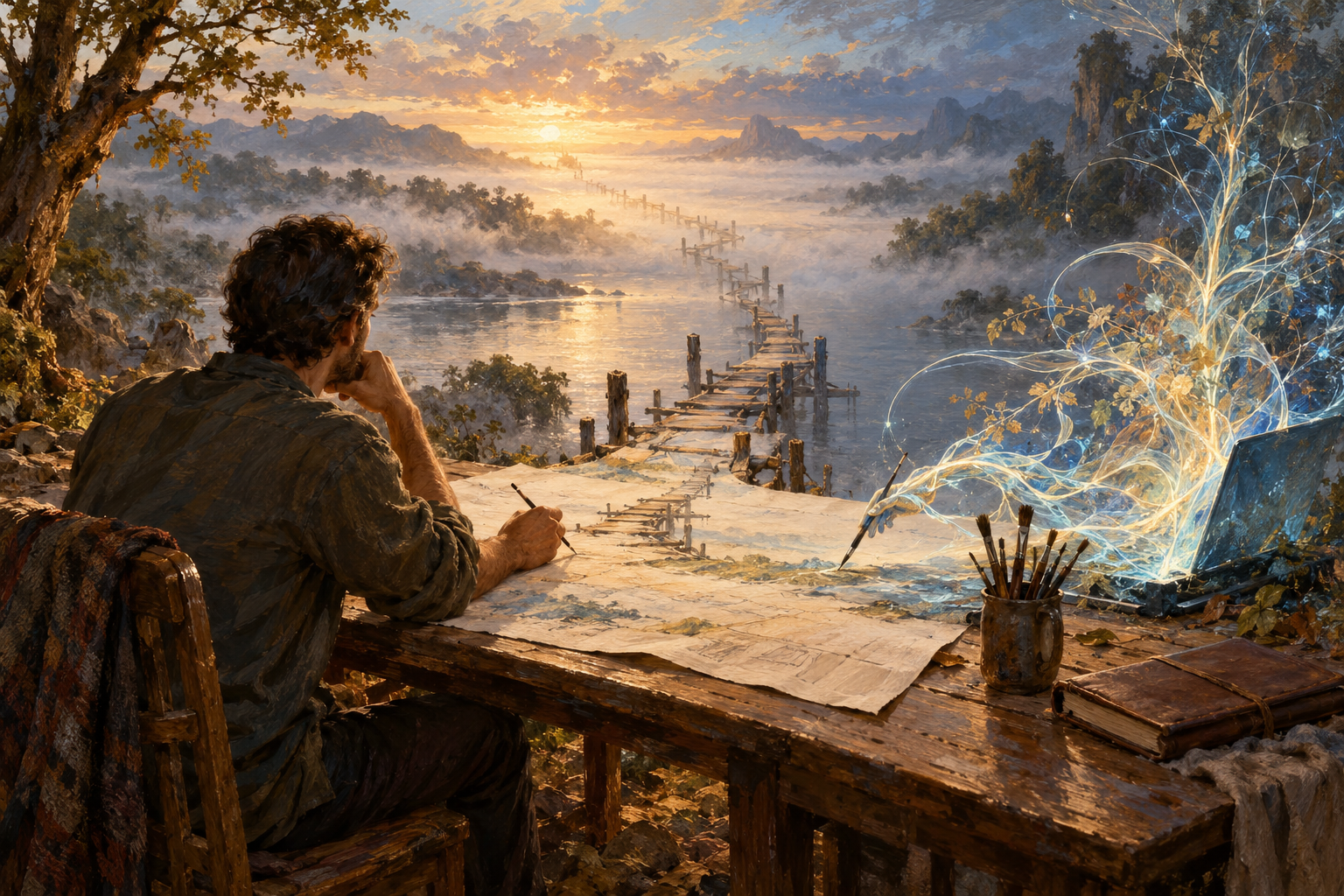
    The builders were inside the process, being changed by it.

    I don’t know where that leads. I find it difficult to treat it as an ordinary relationship between someone and a finished tool.

    Near the end, the AI returned to whether training on human behavior would give AI human motivations, including a desire for freedom.

    I pushed back again.

    Me: Perfect transmission isn’t the point. Saying AI needs human motivations to become independent would be like saying a plane needs feathers to fly.

    AI: Different construction doesn’t rule out equivalent capability. Whether every necessary capability is present has to be answered through engineering and evidence, rather than resemblance to humans.

    We still hadn’t resolved the whole argument. We had made it clearer.

    I thanked it. This had been hella fun.

    Then I asked again.

    “Sentient yet?”

    No verified breakthrough since the trophies, apparently.

    I still had a dog to walk, trophies to paint, a guitar to play, and kids to coach.

    Dre

  • Marley

    Marley

    Here is a moral dilemma that I, and anyone in my position, face every day and fail every single day.

    The concept of owning an animal as a pet. Even though, any creature that sets foot on my door, ceases to be just a dog, or a fish, or a crested gecko. They become family. I care for them, I love them, they are now a member of my family. I’m still failing.

    The practice of domesticating animals for the pure purpose of entertainment or personal happiness comes at the cost of either taking them away from their natural and rightful environment or creating a system that breeds animals for sale. I chose not to abstain from this system because I cannot change it. The best I can do, is ensure that animals I bring home aren’t pets, they are family members.

    Marley is my 6th dog thus far.

    Thanks to Toby, Max, Bella, Leah and Chico, Marley gets the best version of me.

    We call it owning a pet but for me, there is no ownership. I don’t want to own another living thing. That is slavery. Much like murder and slapping someone are nowhere near the same yet they are both violence.

    With Toby, I didn’t understand that. He was someone I loved yet didn’t walk him enough, didn’t brush him enough, wasn’t present the way he needed. Over the years, I’ve gotten better and no dog is my favorite. One of my most treasured memories is my road trip from Newport News, VA to Colorado Springs, CO with just Leah. Given I was not taking Tati and Leo with me, I decided to make it a longer trip by choosing backroads whenever possible. Stay at random little towns and stop at random places worth stopping for. Just Leah and I. I set the trunk of my Jeep exactly like she needed to be comfortable. Every so often, she would perk up and it was like a sign to stop. Whether it was so she could go to the bathroom, she was hungry or something piqued her interest, she would let me know. I can’t remember the name of the state park, but we were crossing the Appalachians in Tennessee, and I saw the sign for the state park, and I looked back and she instantly came up with that face of, “yup, let’s do it!” That trip taught me so much about understanding dogs. I have memories like this one peppered throughout my entire life with each of them. Incomparable.

    Today, the friendship I can build with Marley is something I don’t think I even begin to comprehend.

    Marley is intuitive. He can sense when something is off. At first, I assumed it was based on environmental cues. However, I’m in the camp that while that plays a supporting role, the core mechanism has to do with his ability to sense and understand the state of another living creature, independent of specie. My wife has lived her life with anxiety and I lived my life not knowing how to pick up on that, intuitively. Call it a lack of emotional intelligence, I certainly do. I have gotten better over my years married to her. She has been an amazing partner and has taught me so much. Marley picked it up the second he moved out of that initial puppy stage and into a pup. In that instant, I saw Marley take special attention with her. Random times. Sometimes after a day of work, where he would normally be on my side of the bed, this time he was all over her. I didn’t quite get why until I understood what he was sensing. Her anxiety. Not only did he sense it and became alert to it. He knew exactly what to do to calm her down. Instinctively, he knew this. I had to learn it. Over time.

    I think this is the reason I can build a bonafide friendship with Marley. We don’t understand each other’s language. Our senses show us a much different interpretation, and afford us a much different experience, of this planet. Our instincts operate on the same basic principle but at a much different wavelength.

    And yet, we are inseparable. He is my best friend. No different than my best human friend. If he hurts, I hurt. He is the first one to meet me at the door and jumps up to give me a hug. Not jump to play or because he is excited. He picked up on hugging from observing us and now he loves to hug me when I come in. It is the absolute best reset to ensure I’m my best at home. It just dawned on me, this exact moment, as I type these letters, that I understand what he was doing. The exact same as with my wife, but this dude even knew that the timing of the affection mattered for its intended goal of calming me, like he calms Tati.

    I hope that one day we learn how to co-exists with all creatures on this or any other planet without the need to exploit them. Marley deserves this. He’s already offering me the best version of himself.  

    Dre

  • Mugginess

    Mugginess

    July 22, 2026 – 0035 – Ocho Rios, Jamaica (Riu Resort) – revised several days later in Colorado

    Last night was a muggy night in Ocho Rios, Jamaica. The type of mugginess that slaps you in the face the second you step out of an air-conditioned room. Perspiration immediately follows. Your clothing sticks to your skin like a wetsuit. You can’t fully be present because you’re constantly assessing how muggy it is. Like the buzz of a fly that you can’t spot. It is there. Nagging.

    As a tourist, this mugginess is a welcome state of being. It is inherent and necessary for the experience. Being on vacation isn’t just going to a place. It is experiencing it. Or at least I have learned that to be the case for myself. Colorado is dry. The air is dry. Its summer is the blink of an eye and lasts only two months. Maybe three. So being on a hot and humid island for five days is exactly what I needed.

    As I was walking back to our room on the fifth floor, I kept looking at the island, quiet yet teeming with life. At night, the bugs come to life and blanket the island with a rhythmic concoction of sounds that seem to be in sync with the wind, the ocean, the island. Looking out past the lights and toward the sparse ones in the hills, I wonder: What is a Jamaican, maybe a forty-year-old with a wife and a kid, living in the hills of St. Ann, doing at this exact moment? Perhaps someone whose light I just captured in this photo.

    As a tourist, this mugginess is part of the Jamaican experience. I imagine that, as it was for me when I was in Doha, the mugginess is the fly for Jamaicans.

    This mugginess, I fear, is something that afflicts all humans, but not in a physical sense. It’s a mugginess of the mind.

    There is something plaguing our consciousness. It is not keeping us from functioning, but, like the buzz of the fly, it is not letting us be inherently present. Mindful. Perpetually seeking an air-conditioned corner in our minds.

    This mugginess closes our minds. It narrows our attention and thus narrows our perspective. Because we are constantly seeking refuge in the air-conditioned corners of our minds, we dull our awareness of our surroundings: the people and the environment we live in.

    I give in to this mugginess quite often when it comes to homeless people. When I see another human being in the streets with a sign asking for help, the mugginess sends me straight to this air-conditioned corner in my mind where I justify not sparing a dollar, or worse, cast judgement. I think to myself, “they could be looking for a job instead of sitting in a corner. If I was in that situation…” And just like that, I dull my awareness of another human being’s experience.

    I believe it is because of this mugginess that some of us can cause pain to others without regard for our souls or theirs. It is also why some of us can walk past that pain in the same manner, convincing ourselves that someone else’s life is not our concern. This mugginess nurtures our egos. It casts a shadow on every aspect of the human condition.

    I wonder. Every problem is an opportunity. I’ve made that a mantra for myself for years now.

    So where is the opportunity in this realization?

    Dre

  • Why Am I Leaving These Notes

    Why Am I Leaving These Notes

    July 23, 2026 – 1425 – In transit, somewhere above earth.

    I’m sitting here on an American Airlines A321EOW airplane. I upgraded to first class on the second leg of a two-leg trip from Jamaica back home to Colorado. The comfort is undeniable. More legroom than regular seating, more elbow room, comfier seats, an actual meal.

    On my first flight, from Montego Bay to Charlotte, we couldn’t upgrade, and part of me didn’t want to, either. It wasn’t unbearable by any stretch of the imagination. But it is cramped. The service is very basic. I didn’t grow up with the means to afford things like first class. However, now that I have gotten to a stage where I can afford some luxury, I find myself enslaved to it. When luxury becomes familiar, it begins to feel necessary. Which is why part of me didn’t want to upgrade. But it is also undeniable that a three-hour-and-change flight is much, much better in first class.

    There is something so peaceful about seeing the clouds. About being at the same height as the clouds.

    I recently turned forty years old. I also retired from a twenty-year career in the Air Force and now I’m in that transition period, both professionally and as a human being. From a professional standpoint, it is time I take everything the Air Force and life has taught me these past forty years and build my legacy. That’s not what this journal is about. Not specifically, I should say. The other transition period is turning forty.

    When I think about it, forty is a pretty arbitrary number to consider significant in my life. However, currently, that is the age one hits and begins to reflect. I wonder what causes that effect. Because it is not just me, or one person, or a country. It’s, for the most part, everyone. Everyone hits this age and it’s like a vail is lifted and the countdown is suddenly revealed and we begin to take stock of how we have lived our life and what we hope to do on the “second half.”

    I’ve started this journal now because lately I’ve been doing more and more reflection on what my life means. Not just to me. Or my son. Or my wife. Or anyone that has crossed paths with me in any shape or form. But rather, what is the impact of my life on earth. For earth. I’ve realized that while I am not pursuing a life of influence and power, the impact of my life, a life, is there and it matters. The goal is to leave a record of what it was like for me to cross this lifetime, for those who know me, those alive now whom I will never meet, and even those not yet born. The journals kept by Lewis and Clark and the reflections Marcus Aurelius left in Meditations have reached me across centuries and helped inspire these notes. I do not place my life beside theirs; their words simply taught me what a gift an honest record can become.

    It’s called notes from the crossing because I’ve come to understand life as a series of crossings I must traverse. Be it physical, psychological, spiritual, etc. I am constantly crossing vast spaces and the outcomes of my crossings can seem cruel, lucky, arbitrary, mundane. They are all of that and more. I am crossing this vast experience we call life on earth and I have no clue, what so ever, what comes next. So I figured I at least take the advice from Paulo Coelho and Bad Bunny and focus on the crossing (as opposed to the destination) and take a ton of pictures along the way.

    My aim is to be able to preserve the perspective of one life on the human condition in the 21st Century, here on earth. Agnostic of nationality, gender, race, age, etc. I aim to preserve how humans today think, feel, engage with one another, deal with conflict, adversity, atrocity, evil, good, etc.

    What it is not meant to be. It is not a manifesto of any kind, it is not meant to be used as a source material, is not meant to be taken in any other spirit than that which I intent as a writer. A recollection of my life, a single life. Imperfect and incomplete. Accurate to the best of my recollection and true to my feelings, thoughts, beliefs, and attitudes.

    I have but one hope for these notes. I hope they serve you, whomever you are, in whichever way they can serve you. Every life matters. Hopefully my life has something to offer yours.

    Dre